Why does a bruise change colour and slide down your face?
A bruise is blood in the wrong place
Tiny vessels break under the skin and blood leaks into the tissue around them. Your body then breaks that blood down and clears it - and each stage of the breakdown has its own colour.
That is the whole explanation for the colour sequence. It is not the bruise "healing" in some vague sense; it is haemoglobin being chemically dismantled into products that happen to be different colours.
Haemoglobin becomes biliverdin, which becomes bilirubin. Red, then purple, then green, then yellow, then gone.
The timeline is uneven, and that matters
The usual diagram shows five equal blocks, which teaches something false: that each colour lasts roughly as long as the next.
It does not. The red phase is gone within a couple of days. The yellow-brown drags on for a week or more at the end. A typical course runs something like red at day nothing, purple by day two, green around day five to seven, yellow through the second week, and clear by around day fourteen.
Treat that as a typical course, not a schedule. Individual bruises vary widely, and a bruise that is slightly behind that pattern is not a problem.
One thing worth being precise about, because it comes up: colour cannot reliably date a bruise. A yellow bruise is more than about eighteen hours old, and that is close to the limit of what can honestly be inferred. Studies of clinicians attempting to age bruises from appearance found them correct within 24 hours well under half the time.
Why it moves downward
Leaked blood follows gravity, slipping along the natural planes between tissue layers.
This is why a knock on the forehead can produce two black eyes a couple of days later, and why after eyelid surgery the bruise frequently turns up on the cheeks. The blood did not spread because something went wrong. It ran downhill, through spaces that were always there.
It is a reliably alarming thing to watch, and a reliably harmless one.
Why a black eye goes so dark
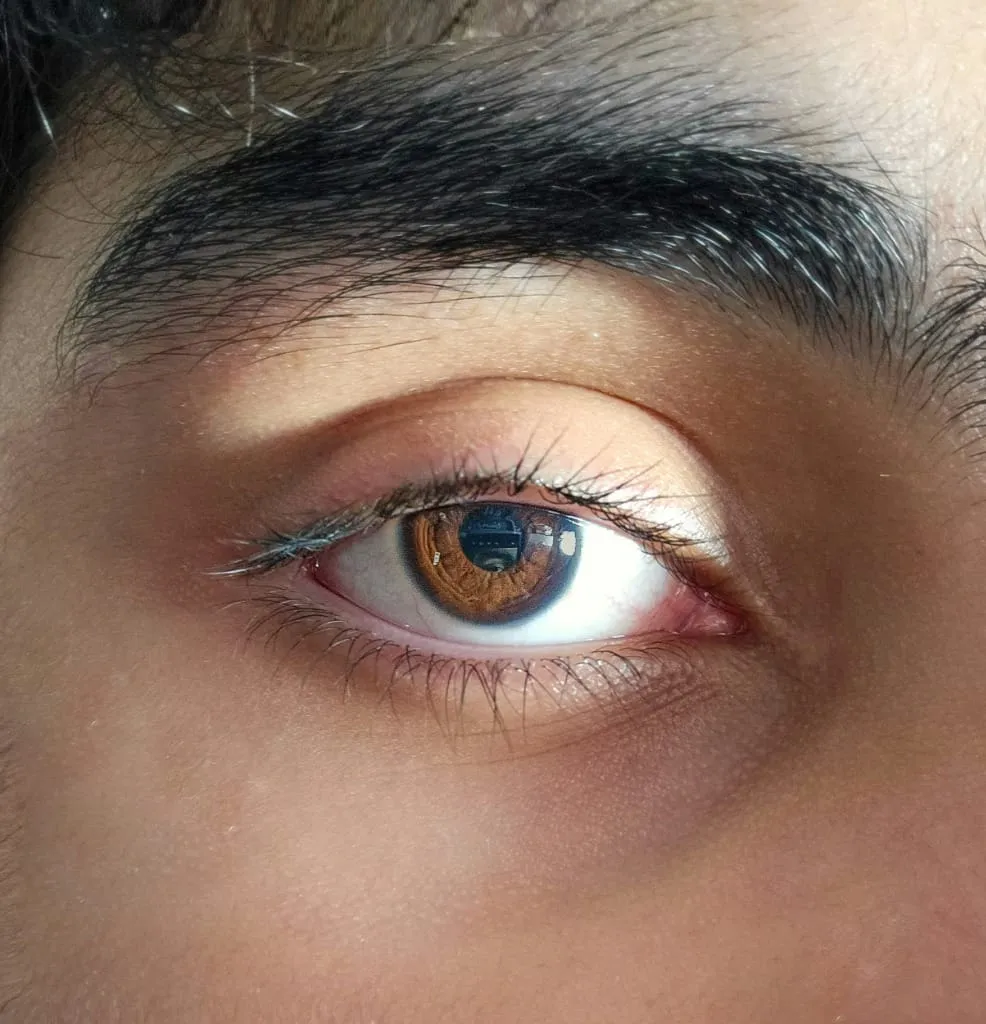
Eyelid skin is the thinnest on the body - roughly a third of a millimetre at the lid margin, with almost no fat beneath it. Under that sits loose areolar tissue that accepts a large volume of blood and conceals essentially none of it.
Thin skin, nothing to hide behind, and plenty of room to fill. That combination is why eyelid bruising looks disproportionately dramatic compared with the same volume of blood almost anywhere else on the body.
When a bruise needs a doctor
Most bruising after surgery is uneventful. These are the exceptions:
Blood may be collecting in a pocket rather than dispersing through tissue. After surgery, that warrants a call the same day rather than waiting for the next scheduled appointment.
Bruising also interacts with swelling, which follows its own curve and peaks later than most people expect. The two together account for almost everything that alarms patients in the first post-operative week.
Purple, then green, then yellow. That is healing on schedule.
Have Questions?
Discuss your specific needs and expected outcomes with Dr. Sumit directly.
Request Consultation