What actually decides how a surgical scar heals
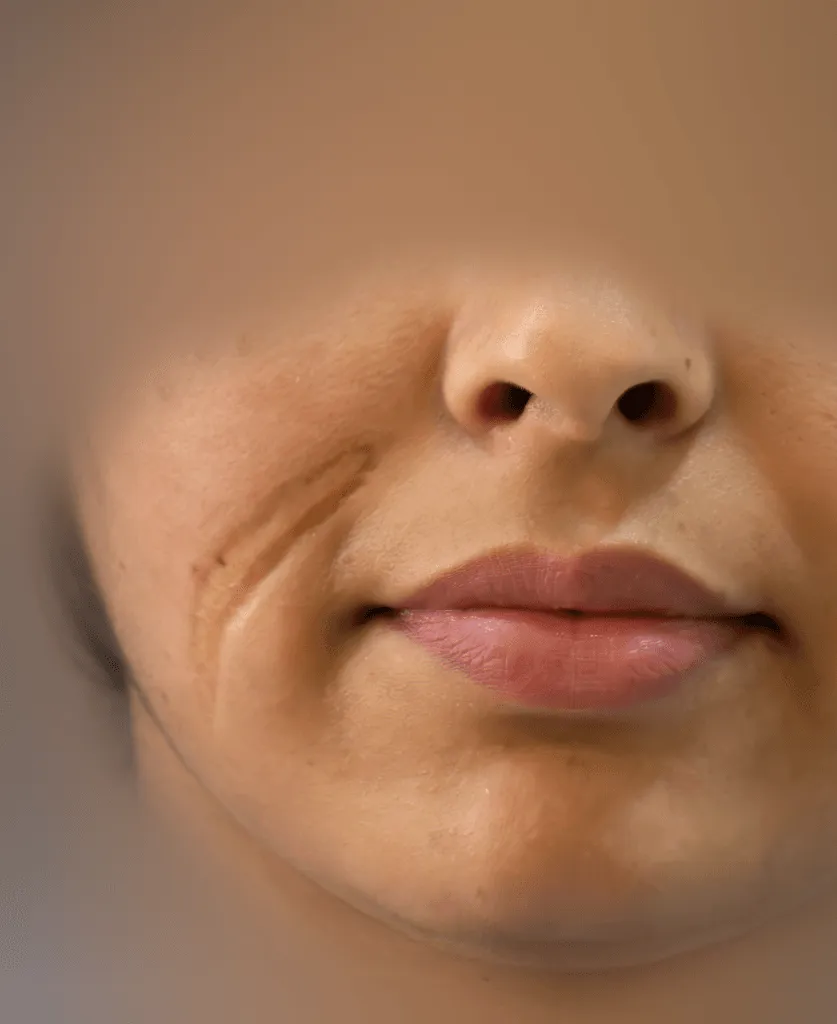
Two cuts, same surgeon, different scars
Put a neat twelve-centimetre incision next to a two-centimetre one and ask which will scar worse. Almost everybody picks the long one. Almost everybody is wrong.
A twelve-centimetre line can heal until it is hard to find. A two-centimetre one can spread into a wide, pale band that never quite settles. The difference between them is not length, it is not the surgeon's eyesight, and it is not the thread. It is tension - how hard the skin is pulling to get back apart.
That one variable explains most of what patients notice about scars: why some fade and some do not, why the same operation scars differently on a chest than on an eyelid, and why the most important stitches in your closure are the ones you will never see.
Skin under pull heals wide
Hold a wound shut by force and the body does something logical and unhelpful. Collagen lays down along the direction of that pull, and the scar spreads sideways - not during the operation, but slowly, for months after the stitches are gone.
This is why location predicts scarring so reliably. The chest, shoulders and back are under constant tension from ordinary movement; every breath and every reach tugs at a healing line there. Eyelid skin barely moves. Same surgeon, same technique, same care - and predictably different results, because the mechanical environment is different.
It is also why a scar can look good when the stitches come out and disappoint six months later. The spreading happens after everyone has stopped looking.
The stitches that matter are the ones you cannot see
If tension writes the scar, the job during closure is not to hold the skin together. It is to make sure the skin never has to hold anything at all.
That work happens in the deep layers. Sutures placed in the tissue beneath take the load off the surface entirely, so that by the time the skin edges are brought together they are resting against each other rather than being dragged. A surface closure over a properly offloaded deep layer barely has a job to do.
Get that wrong and no surface technique rescues it. You can close skin beautifully over a wound still under tension, and it will still spread, because the force is still there. The visible stitches were never the ones doing the work.
This is the single biggest reason two surgeons can perform the same named operation and produce scars that look nothing alike.
What the instruments have to do with it
Here is one that surprises people. Given smooth forceps and forceps with teeth, most patients assume the toothed ones are the more brutal instrument.
It is the other way round.
Smooth forceps look kinder, but to hold skin at all they need real squeeze - and that squeeze crushes the wound edge. Toothed forceps grip with almost no pressure, because the teeth do the holding. Crushed tissue at the edge dies, and a dead edge heals into a wider scar.
This has a name, atraumatic tissue handling, and it is not a modern refinement. It is one of the principles William Halsted set out in 1904, and it remains much of what separates a good closure from an average one.
It is also completely invisible. No patient watches their own operation, and nobody can look at a finished scar and say which forceps made it - which is precisely why it is the kind of thing that gets skipped.
How fine does the thread get? And why it is not the answer
Surgical suture runs on a scale that goes backwards: 3-0 is thick, 6-0 is fine, 8-0 finer still. More zeros, less thread.
To put that in something you can picture, a human hair is roughly 80 microns across. A 3-0 suture is about 225 microns, a 5-0 around 125, a 6-0 about 85. At 8-0, around 45 microns, the thread is thinner than the hair growing beside it, and it is handled under loupes or a microscope because it sits at the limit of what an unaided eye can follow.
Thread is matched to site. Thick skin under tension - a back, an abdomen - needs something that holds for weeks. Eyelid skin needs thread fine enough that the closure leaves no cross-hatching behind it.
All of which is real craft, and none of which decides your scar.
Tension does. A wound closed under tension heals wide whatever it is stitched with. Fine thread only starts to matter once the tension has been dealt with somewhere deeper. It is the last refinement on a result that was settled before the skin was reached.
Your stitches are not holding you together
A related misconception, and a more consequential one.
Stitches hold the wound *edges next to each other*. They do not hold the wound *closed*. The wound closes itself, slowly, underneath them - and that takes far longer than the stitches stay in.
This explains two things patients find alarming.
Why stitches come out early. Left in longer, sutures leave their own marks. So they are removed while the wound is still mechanically weak, and tape or dressings carry it from there. The wound is not finished when the stitches go; it is simply past the point where they help more than they cost.
Why wounds open weeks later. Someone feels completely well, lifts something heavy at three weeks, and is shocked when the wound gives. The skin looked healed a fortnight earlier. It was not. At two weeks a wound holds only a small fraction of the strength it will eventually reach.
If you take one practical thing from this: the restrictions you are given after surgery are not about pain, and they are not caution for its own sake. They track a strength curve you cannot see.
A scar is not an event, it is a year
A scar does not form and then sit there. It remodels continuously for roughly a year - red, then pink, then pale, then quiet. The angry phase is not a bad outcome. It is a stage, and it is the stage during which most patients form their opinion of the result.
Judge a scar at twelve months. Not at two weeks, and not at three months either.
That single reframe prevents a great deal of unnecessary distress, and occasionally prevents someone seeking revision of something that was going to settle perfectly well on its own.
What you can actually influence
Most of what determines your scar is decided in theatre, by tension and by handling, before you wake up. But not all of it.
Silicone gel or sheeting is the measure most often recommended once a wound has fully closed. It is worth an honest caveat: the Cochrane review of silicone gel sheeting found only weak evidence for preventing abnormal scarring, with trials of poor quality and high risk of bias. It is reasonable to try and unlikely to harm, but it is not the decisive factor some marketing suggests - and it is not a substitute for a closure done under no tension.
It is also worth saying plainly that keloid and hypertrophic scars are a different problem. They involve an individual predisposition that runs in families and is commoner in some skin types, and they are not simply the product of poor technique. If you scar that way, tell your surgeon before your operation rather than after.
When a scar is worth revising
Some scars do need addressing - wide, tethered, raised, pigmented, or sitting somewhere that catches with every movement. Scar revision is its own operation, and it works on exactly the principles above: releasing the tether, redistributing the tension, and closing the new line in layers so the replacement gets the environment the original never had.
Timing matters. Revising too early means operating on tissue that has not finished remodelling and might still improve on its own. Letting a scar mature gives a far better sense of what actually needs changing.
If you are planning surgery where the scar is part of the decision - an abdominoplasty, a breast reduction, an eyelid procedure - that conversation belongs in the consultation, before anything is booked. Preparing properly for that first consultation makes it a far more useful hour.
Most of surgery is what you do not do to the tissue. The scar you end up with was largely decided by things that happened where you could not see them: how the edges were held, where the load was carried, and whether the skin was ever asked to do work that was not its job.
Have Questions?
Discuss your specific needs and expected outcomes with Dr. Sumit directly.
Request Consultation