One of these is young skin. The other is a scar. Guess which.
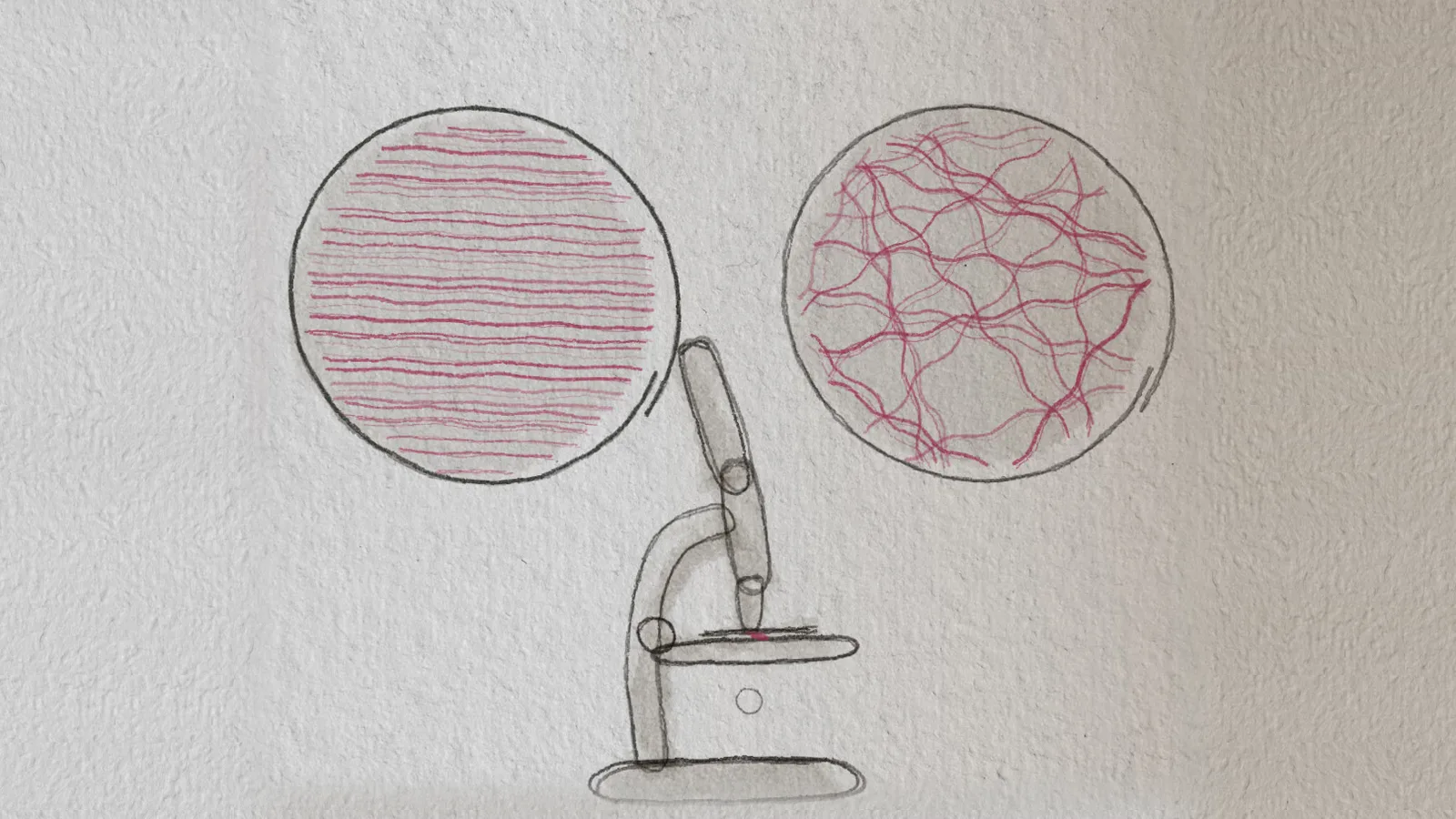
The tidy one is the scar
Look at two samples of skin under a microscope. One shows fibres running in neat, parallel lines. The other is a tangle, fibres crossing in every direction like a loosely woven basket.
Most people pick the tidy one as healthy. It is the scar.
Young skin is a messy weave of fibres. A scar is the same fibres, laid in straight lines. In a study of 194 biopsies, normal skin collagen was randomly oriented, and every type of scar examined was more parallel than the skin around it.
So what are these fibres?
Your skin is held up by ropes
Under the surface sit protein ropes called collagen, made by builder cells in the dermis called fibroblasts. Collagen is what keeps skin firm and resists it being pulled apart.
But ropes do not bounce back. Stretch a rope and let go, and it stays where you left it.
The bounce comes from rubber bands
Woven between the ropes are elastic fibres - an elastin core on a scaffold of fine microfibrils. They stretch and spring back.
Pinch the back of your hand and let go. That snap back is mostly them.
Your rubber bands are barely replaced
Collagen is renewed, slowly: the estimated half-life of skin collagen is around 15 years. Elastin is hardly replaced at all. Its turnover is so low that damage simply accumulates; in the one tissue where its age has been measured directly, the lung, it averaged around 74 years old.
Some treatments can raise the amount of elastin in skin. A randomised split-face trial of radiofrequency microneedling, for instance, measured more of it. But more elastin is not the same as rebuilt, organised elastic fibres, and no study I have found shows the second. Making more is the easy part. Weaving it back is the hard part.
The sun cuts both
Ultraviolet light switches on enzymes in the skin that cut collagen and elastic fibres. It does this at doses too weak to make you go red - a sunburn is not required.
The skin repairs each cut, but imperfectly. Researchers who described this mechanism proposed that every imperfect repair leaves behind a tiny "solar scar", and that years of them add up to sun-aged skin.
So "more collagen" is the wrong goal
A scar is mostly collagen. So "this treatment makes collagen" tells you very little on its own.
The real question for any treatment is which one it produces: true skin rejuvenation, or scarification - new collagen woven like young skin, or new collagen laid down like a scar?
So I went looking for the biopsies.
Fillers and "biostimulators" do make collagen
Biopsies show it. Hyaluronic acid fillers, poly-L-lactic acid and calcium hydroxylapatite all lead to new collagen around the injected material.
But where the images show how that collagen is arranged, it is packed tightly around the filler like a casing, not woven back through the skin. With hyaluronic acid, the new bundles were described as densely packed around pools of gel. Poly-L-lactic acid produces a capsule. PMMA microspheres end up encapsulated in new collagen fibres.
Did anything bring the weave back?
No study I found shows the weave return
I searched for any synthetic filler, biostimulator, thread or polynucleotide study that measured how the new collagen was arranged and found it matching young skin. I did not find one.
The closest is a hyaluronic acid study in people over 70 that described the new collagen bundles as "resembling those observed in young skin." That description was qualitative. And when the same research group imaged the same kind of change with a technique designed to show fibre arrangement, they found thick bundles densely packed around the gel.
This is a statement about what has been shown, not proof that it can never happen. But it is a reason to be sceptical when a product is sold on "collagen".
A controlled burn can rebuild the top layer
A deep chemical peel burns away the sun-damaged upper dermis in a controlled way.
Biopsies taken between 1.5 and 20 years after deep phenol peels found a new band of connective tissue beneath the surface, with a dense network of fine new elastic fibres. That is the closest thing to a rebuilt weave I found in the literature.
There is a catch. The same study found that the peel permanently impairs the skin's ability to make pigment, leaving it lighter. On Indian skin, deep peels can be tricky - the contrast with untreated skin shows, and the risk of uneven pigmentation is real. It is a treatment that needs careful selection, not a routine one. Lighter chemical peels work on a much more superficial level.
Your own fat tells the builders to rebuild
Fat is not just volume. It carries cells - including stromal and stem cells - that send repair signals to the fibroblasts around them.
In a small biopsy study of six facelift patients, injected fat-derived cells were followed by less sun damage (elastosis) and fine new elastic fibres in the treated skin. Six patients is a small number, and the evidence for nanofat specifically is still rated as low. But it is the direction the biology points, and it comes from your own tissue.
And it does two jobs at once.
I fix volume and skin in one sitting
In one session I place your fat where volume has been lost - fat grafting - and then process the rest into nanofat and needle it into the skin itself.
Nothing foreign stays behind. There is no product for collagen to wall off, because the material is your own tissue.
But first, stop the cutting
None of the above is worth much if the sun keeps cutting.
These are cheap, unglamorous and better evidenced than most of what is sold as "collagen".
What to ask before your next "collagen" treatment
Not "does it make collagen?" Almost everything does, including a scar.
Ask what the new collagen looks like under a microscope, and whether anyone has shown it woven like young skin rather than packed like a scar. If the answer is a brochure rather than a biopsy, that is your answer. (If it is a scar you want improved rather than ageing skin, what decides how a surgical scar heals is the place to start.)
Young skin isn't more collagen. It's the right weave.
Have Questions?
Discuss your specific needs and expected outcomes with Dr. Sumit directly.
Request Consultation